
If your employer has not paid your gratuity in the UAE, your immediate step is to file an official labour complaint with the Ministry of Human Resources and Emiratisation (MOHRE) within 1 year of your final working day. Under Article 53 of the UAE Labour Law, companies must release all end-of-service benefits within 14 days of contract termination.
Do not rely on verbal promises or informal phone calls. Most importantly, never sign your visa cancellation form until the cash is physically in your hand or fully cleared in your bank account, as signing it legally declares you have received all your dues. For a full breakdown of end-of-service rights, consult our Complete Guide to Gratuity in UAE.
What Is the Legal Deadline for an Unpaid Gratuity UAE Case?
The legal framework in the United Arab Emirates is highly structured and precise about timing. Once your employment relationship officially ends, a strict countdown begins for both parties. Understanding these specific timelines helps you take action before your rights are compromised.
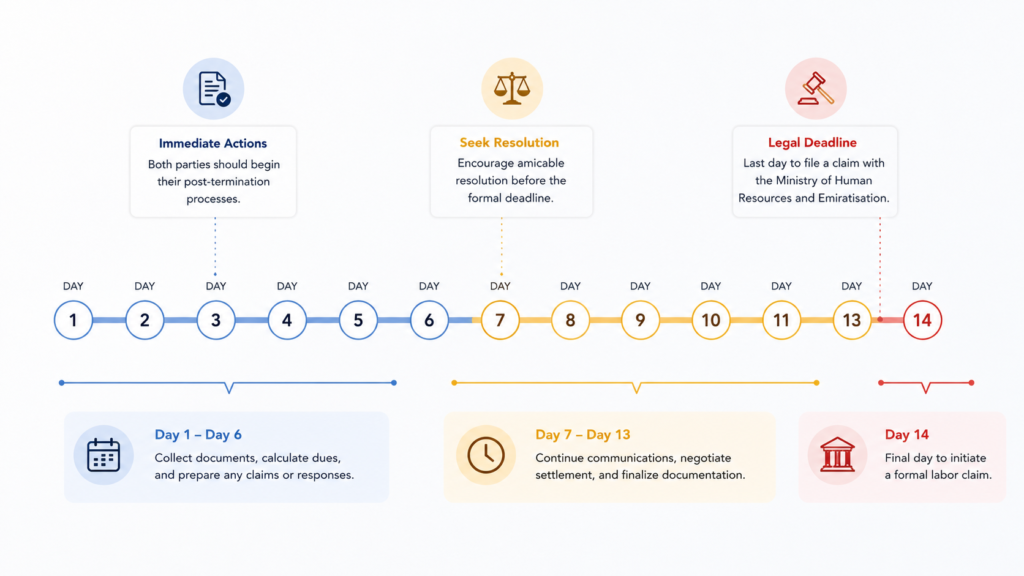
The 14-Day Settlement Window
According to Article 53 of Federal Decree-Law No. 33 of 2021, an employer has exactly 14 days from the official date of contract termination to pay all salaries, leave entitlements, and end-of-service gratuity. This is a strict statutory requirement. It does not matter if the company is experiencing a temporary cash crunch, waiting for client clearances, or processing internal audits. The 14-day window is a hard boundary.
The 1-Year Statute of Limitations
If your employer completely ignores this deadline or continues to offer vague delays, you must keep an eye on the calendar. Under UAE law, labor claims are subject to a strict 1-year statute of limitations. This means you have exactly 12 months from the date your payout became due to file an official legal dispute. If you let negotiations drag out past 12 months without registering a formal complaint with MOHRE, you lose the legal right to pursue those funds in court.
Before launching a claim, ensure your numbers align with ministry guidelines by learning How to Calculate Gratuity in UAE.
How to File an Official Labour Complaint UAE
When internal communication fails and your employer refuses to cooperate, you must transition from informal messaging to the official government dispute process. This formal mechanism ensures your grievances are documented and evaluated by appropriate legal authorities.
The 3-Step Dispute Resolution Process
Step 1: Online Case Registration
First, you must register your case digitally through the MOHRE Smart App or the official MOHRE website using your UAE PASS credentials. If you prefer in-person assistance, you can visit a physical Twafouq Center, which are specialized service facilities authorized by the government to handle labor disputes. During this stage, you must upload your evidence:
- Your official MOHRE employment contract.
- Your signed resignation letter with proof of delivery, or your official termination notice.
- Bank statements showing your historical salary transfers (to establish your true basic wage).
- Written correspondence, such as emails or WhatsApp messages, proving you requested your payout.
Step 2: Legal Mediation (Twafouq Phase)
Once your case is submitted, a government legal researcher will open your file and initiate a mediation phase. The mediator will call both you and your employer to discuss the dispute over the phone or via a virtual meeting. There are only two outcomes here:
- Amicable Settlement: The mediator explains the legal consequences and penalties to your employer. Realizing they cannot bypass the law, the employer agrees to pay your dues. Once the funds clear, the case is closed.
- No Agreement Made: If the employer refuses to pay, disputes the core math, or simply fails to answer the mediator's calls, an amicable settlement cannot be reached. The mediator will then close the file and issue an official case transfer letter, allowing you to escalate the matter.
Step 3: Moving to UAE Labour Court
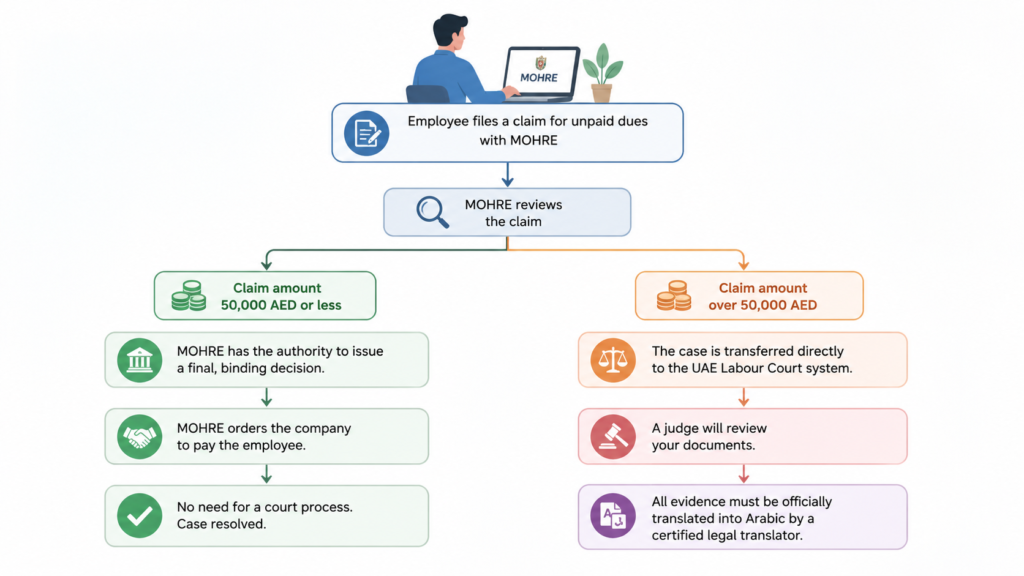
The final legal path depends entirely on the total monetary value of your unpaid dues:
- Claims under 50,000 AED: Under recent updates to the UAE legal framework, MOHRE has the authority to issue a final, binding decision for low-value claims. They will order the company to pay without forcing you to undergo a lengthy judicial court process.
- Claims over 50,000 AED: If your total unpaid gratuity and pending salary exceed 50,000 AED, the case is transferred directly to the UAE Labour Court system. At this stage, a judge will review your documents, and all your evidence must be officially translated into Arabic by a certified legal translator.
Eligibility and Calculation Realities
Before launching a formal case, you must ensure your employment history satisfies the baseline legal criteria for an end-of-service payout. Miscalculating your entitlement can weaken your credibility during the mediation phase.
The 1-Year Milestone
To qualify for any end-of-service gratuity in the private sector, you must complete at least 1 year of continuous service with your employer. If you resign or are terminated before hitting the 365-day mark, you are not legally entitled to a gratuity payout under standard circumstances.
The Basic Salary Rule
Your end-of-service benefits are calculated strictly using your last basic salary listed on your official MOHRE contract. Variable allowances like housing, transportation, commissions, or schooling fees are completely excluded from the calculation unless a specific, non-standard clause in your contract states otherwise.
Unpaid Absences
Continuous service means working without unauthorized gaps. If you took unauthorized time off, or if you had periods of extended unpaid leave, those specific days are excluded from your total days of service. For a detailed breakdown of how missing days alter your final number, read about Unpaid Leave Gratuity UAE.
Real-World Case Studies: Rushed vs. Patient Approaches
To understand how these laws protect you, let us look at two realistic scenarios based on typical expat experiences in the UAE market.
Case Study 1: Tariq's Costly Mistake
Tariq worked as a logistics coordinator for 3 years. His relationship with his manager was excellent. When he decided to return to his home country, his company told him that client payments were delayed, making it hard to pay his 18,000 AED gratuity immediately.
The HR department promised to wire the funds to his home country bank account within 30 days if he signed the visa cancellation paperwork first so they could clear their company visa quota. Trusting his manager's verbal promise, Tariq signed the cancellation document, which explicitly stated he had received all his financial dues.
Once he landed back home, the company stopped replying to his emails. When he filed a complaint from abroad, the mediator pointed out that his signed cancellation paper served as a legal declaration that he was fully paid. Tariq had to hire legal help from abroad, turning his simple claim into a long, stressful battle.
Case Study 2: Anna's Protected Victory
Anna worked as a graphic designer for the same duration. When she resigned, her employer offered a similar excuse, asking her to sign the visa cancellation papers with a promise of a future cheque. Remembering the golden rule, Anna politely refused. She stated that she would happily sign the cancellation paperwork the moment the money cleared in her bank account.
When the company tried to pressure her, she stopped negotiating and logged into the MOHRE app to file a dispute. Within 4 days, a MOHRE mediator called both parties. The mediator informed the employer that withholding payment while demanding visa cancellation violates Article 53, which carries heavy corporate fines. Realizing they could not bypass the system, the company issued a manager's cheque. Anna walked to the bank, cashed the cheque, and only then signed the visa cancellation form.
Hidden Pitfalls: Mistakes That Will Cost You Your Payout
When you are stressed about unpaid money, it is easy to make quick, emotional decisions that can accidentally damage your legal standing. Protect your interests by avoiding these critical traps.
Accepting Vague Verbal Timelines
Never accept statements like "We will pay you when the company gets its next investment round" or "We will transfer it next quarter." If your company is facing severe operational financial problems, you need to file your claim immediately. Waiting allows other creditors to clear out the company's accounts before you get your share.
Walking Away From Your Job Early
If your employer stops paying you, do not simply walk away, stop showing up to work, or leave the country before your notice period officially ends. Doing so gives the employer a legal weapon. They can file an "absconding" report against you. An absconding report can trigger an immediate employment ban, cancel your labor rights, and completely forfeit your right to accumulated gratuity.
Falling for Visa Deduction Scams
It is very common for uncooperative employers to try to subtract recruitment costs, visa allocation fees, medical testing fees, or agent commissions from your final end-of-service check.
Important Legal Truth: Under the UAE Labour Law, it is completely illegal for an employer to pass any recruitment or onboarding expenses onto the employee, regardless of whether you resigned or were terminated. Any such unauthorized deductions should be flagged immediately during mediation.
Advanced Legal Strategies for Complex Disputes
What If the Company Is Bankrupt or Closed?
If a company shuts down, enters liquidation, or declares formal bankruptcy, employees often worry that their hard-earned money is gone forever. Under UAE corporate and labor laws, employee salaries and end-of-service gratuities are legally categorized as preferential debts. This means that when a judge orders the liquidation of a company’s commercial assets (such as office property, vehicles, or bank funds), employees are placed at the very front of the line. Your unpaid benefits must be cleared before the liquidation funds can be used to pay off commercial banks, corporate suppliers, or landlords.
Handling Discrepancies in Arbitrary Deductions
Sometimes an employer will agree to pay your gratuity but will present a calculation that is thousands of dirhams lower than your expectations. They might claim you damaged company equipment, underperformed, or caused a loss of client revenue. Under the law, an employer cannot make arbitrary deductions for damages unless they have a formal, written internal investigation report that you signed, or a direct court order. If they attempt to slice away your benefits based on subjective claims, do not accept the payment as a final settlement. Present your exact basic salary figures to the MOHRE mediator to reset the math.
Future Security: The Shift to Corporate Savings Schemes
To completely eliminate the issue of employers running out of cash to pay departing staff, the UAE is transforming its employee benefit structures. The country is actively transitioning towards modern, institutional investment frameworks. The government has introduced alternative end of service savings schemes. Instead of forcing companies to pay a massive, unmanaged lump sum out of their operational cash flow when an employee leaves, this new system allows employers to make regular monthly contributions into independent, government-approved investment trust funds on behalf of their staff.
How This Protects Your Cash
This structural shift provides massive financial security for the expat workforce:
| Scheme Safeguard | Operational Execution & Legal Value |
|---|---|
| Asset Insulation | Your accumulated gratuity money is completely ring-fenced and kept entirely separate from your employer's commercial bank accounts. |
| Bankruptcy Protection | If your company goes bankrupt or faces sudden financial collapse, your transition savings remain completely untouched and safe within the independent trust fund. |
| Investment Options | Depending on the specific fund structure, employees can choose how their accumulated funds are managed, allowing their end-of-service capital to grow safely over time. |
Calculation: Actions Checklist
- Verify Service Length: Confirm that you have crossed the 1-year mark of continuous employment.
- Calculate Your Baseline: Know your exact entitlement using your contract's basic salary figure.
- Secure Your Communications: Export all WhatsApp chats, print relevant emails, and save your official contract to an external drive.
- Refuse Early Visa Cancellation: Politely decline to sign any cancellation documents that contain a fully paid satisfaction clause until your money clears.
- Monitor the 14-Day Post-Termination Mark: Give your employer a clear written reminder as the 14-day legal window approaches.
- File via MOHRE Digital Portals: If day 15 arrives without payment, log in via UAE PASS and immediately open an official labor dispute.
Frequently Asked Questions
Can my boss withhold my gratuity if I am fired for a mistake?
No. Under the current UAE Labour Law, you retain your accrued end-of-service benefits even if you face termination under Article 44 for workplace misconduct. Historical provisions allowing employers to completely forfeit payouts have been abolished.
How long does an employer have to pay out after termination?
The standard statutory requirement states that all pending payments including final wages, unused leave allowances, and gratuity must be settled within 14 calendar days from the official date of termination.
Can I file a MOHRE complaint if I already left the UAE?
Yes. You are permitted to lodge a legal labor dispute online through the official MOHRE application or web portal via your UAE PASS, as long as you open the file within 1 year from your contract's end date.
What happens to my money if the company goes bankrupt?
Your unpaid benefits are classified as preferential debts. If a liquidation process occurs, a judge ensures corporate assets are used to pay outstanding employee balances before settling corporate liabilities with suppliers or banks.
Can an employer deduct training or visa fees from my gratuity?
No, such operational charges cannot legally be transferred to staff. The law strictly prohibits companies from reducing your settlement sum to cover onboarding, visa fees, or mandatory recruitment overheads.
What should I do if my employer threatens to block my future visas?
Remember that corporate entities cannot arbitrarily issue immigration restrictions. True employment bans are determined solely by government authorities following strict regulatory violations; pursuing legal dues will not trigger a ban against you.
Can I accept a partial payment and claim the rest later?
You may accept partial compensation only if you execute a formal, written supplemental agreement establishing the remaining balance as outstanding. Do not execute your permanent visa cancellation form until the full amount is settled.