
To claim unpaid gratuity UAE, an employee must submit an official labor complaint through the Ministry of Human Resources and Emiratisation (MOHRE) digital channels if their employer fails to clear their end-of-service settlement. This formal recovery process is managed online via the MOHRE smart app, the corporate website portal, or by calling the dedicated worker helpline at 600590000. Under current UAE labor regulations, this government-backed system allows expatriate workers to recover their money directly without the upfront cost of hiring a private legal firm.
According to UAE Decree-Law No. 33 of 2021 (the UAE Labour Law), your final settlement is a strict statutory right that cannot be negotiated away, waived, or withheld by your employer. When a company misses the legal payment window, the state provides a clear, free framework to file a dispute, enter state-backed conciliation, and secure your funds.
The Legal Foundations of Gratuity Recovery in the UAE
Filing an official dispute requires a firm understanding of the exact legal parameters that govern end-of-service claims. The recovery process relies on specific statutory timelines and contract realities that dictate how claims are evaluated by government authorities.
The 14-Day Settlement Rule
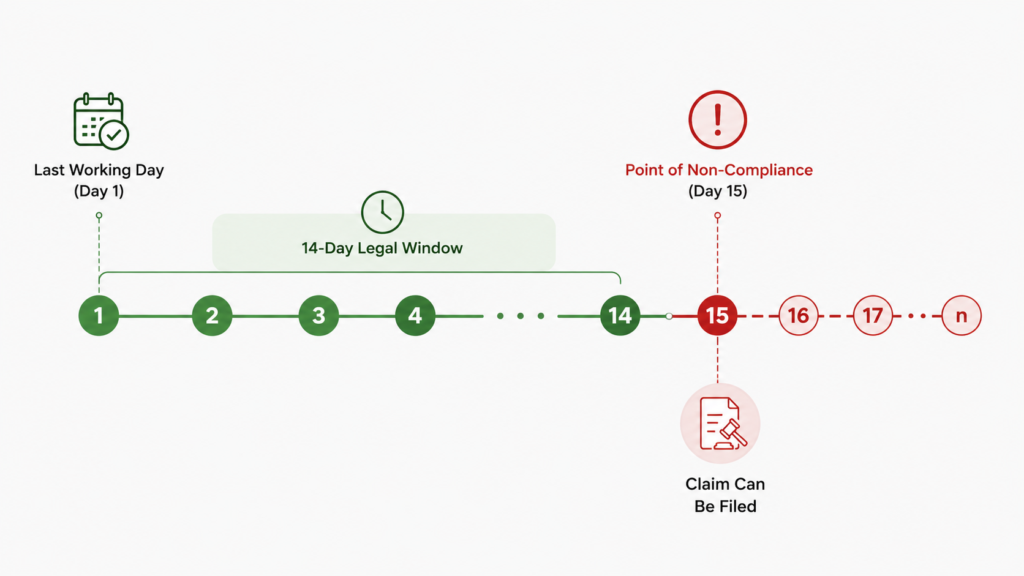
Article 53 of the UAE Labour Law states that an employer must pay all employee entitlements within 14 days from the date an employment contract terminates. This countdown begins on your official final working day as specified by your visa cancellation or termination paperwork, not when you hand in your initial notice of intent.
The 1-Year Statute of Limitations
Under Article 6 of the federal labor law, any legal action regarding employment entitlements expires exactly 1 year after the date the payment became due. If you do not formally log a complaint with MOHRE within 12 months of your last working day, you lose your statutory right to use the state court system to recover gratuity UAE from that specific employer.
How to Claim Unpaid Gratuity UAE: The 4-Step Recovery Process
The Ministry of Human Resources and Emiratisation has digitized the labor dispute framework to protect workers. If your company refuses to pay your end-of-service dues, follow these 4 operational steps to recover your funds.
Step 1: Send a Formal Written Demand Notice
Before initiating government intervention, you must establish clear documentary evidence that you attempted to settle the matter internally. Send a structured email to your company's HR director, business owners, and direct supervisors. This step creates a critical, unalterable paper trail for government mediators.
- State your precise final working date based on your employment records.
- Itemize your exact calculated gratuity balance and any outstanding regular salaries.
- Quote the 14-day statutory payment mandate under UAE Labour Law Article 53.
- Provide a firm deadline of 3 business days for the company to issue a bank transfer or provide a validated bank receipt.
Step 2: Compile Your Digital Evidence Folder
If the company ignores your written demand notice, do not waste time on verbal arguments. Assemble your digital documentation folder immediately so it is ready to upload when filing your case. Note: Keep files in clear PDF or JPEG formats under 5MB to ensure they pass the MOHRE system upload filters smoothly. This folder must contain:
- Your latest digital UAE employment contract, which can be downloaded instantly from the MOHRE smart app.
- Your official resignation email with delivery confirmations, or the corporate termination letter.
- Your official bank account statements from the last 6 months showing your historical monthly basic salary deposits.
- The final settlement worksheet prepared by HR, or any text messages and emails where the company acknowledged your specific gratuity calculation.
Step 3: Lodge an Official Labour Dispute with MOHRE
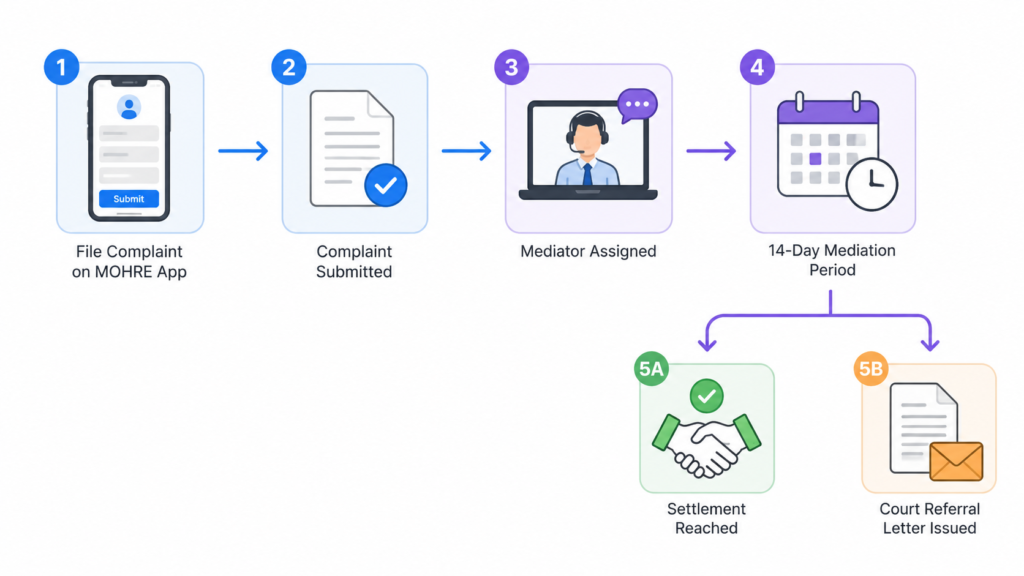
When internal negotiation fails completely, you must escalate the matter to state regulators. You can lodge your official non-payment dispute through three official channels:
- The MOHRE Smart App: Download the application on your smartphone, authenticate your identity using your verified UAE Pass app, select the "Register Labour Complaint" service, and input your claim details. Ensure your contact phone number is current, as system notifications are pushed here directly.
- The MOHRE Online Portal: Visit the official website, log into the employee services section, and complete the digital dispute form.
- The MOHRE Helpline: Call 600590000 to speak directly with an agent who will input your claims into the regulatory database.
Once your dispute is logged, MOHRE will assign a dedicated legal mediator to your file. The mediator will schedule a mandatory joint conciliation meeting via a phone conference or video call between you and an authorized representative of your employer. The mediator’s job is to review the contract, verify your calculations, and pressure the employer to settle without a trial. This mediation service is entirely free of charge.
Step 4: Request a Labour Court Referral Letter
The mediation phase generally concludes within 14 days of filing your complaint. If your employer refuses to participate in the hearings, denies your statutory rights, or presents an unacceptable payment schedule, the mediator will officially close the amicable settlement file.
The mediator will then issue you an official Labour Dispute Referral Letter alongside a written case summary. This document grants you the legal permission to file a formal lawsuit within the UAE Labour Court system, allowing a judge to issue binding execution orders against the employer's commercial bank accounts and corporate assets.
Real-World Example: Recovering a Delayed Payout from a Mainland Company
To understand how this recovery framework operates under real conditions, look at the case of Tariq, an operations coordinator who worked for a mainland transport company in Dubai for 5 years. Tariq’s basic salary was 7,000 AED per month. After resigning properly and completing his 30-day notice period, his company processed his visa cancellation but withheld his 35,000 AED final gratuity payment, claiming corporate cash flow problems.
Tariq waited 20 days, receiving nothing but verbal promises from the company's general manager. Realizing the 14-day legal window had passed, Tariq executed the following steps:
- He compiled his digital labor contract, visa cancellation receipt, and bank logs into a single PDF folder.
- He opened a formal non-payment complaint through the MOHRE mobile application.
- During the scheduled mediation phone call, the employer tried to negotiate a 40% reduction in the settlement, claiming market challenges.
- The MOHRE mediator rejected the employer’s argument, stating that end-of-service gratuity is an absolute statutory right that cannot be discounted. The mediator informed the company that a failure to settle would result in immediate corporate portal blocks.
- To avoid government penalties, the employer transferred the full 35,000 AED to Tariq’s bank account within 72 hours, closing the case before court escalation.
Critical Pitfalls to Avoid During Your Gratuity Recovery
When navigating an employment dispute, making a single procedural error can compromise your legal standing. Avoid these 3 common mistakes to protect your financial interests.
1. Signing the Visa Cancellation Document Before Receiving Funds
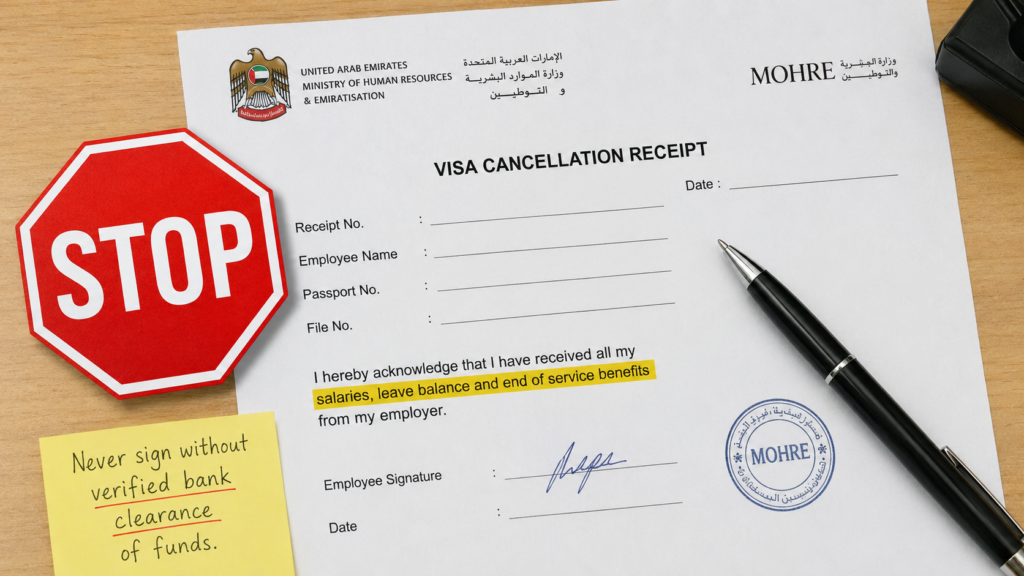
This is the most dangerous error made by expatriate workers in the UAE. The standard MOHRE visa cancellation form features an explicit printed statement where the employee declares they have received all of their salaries, leave balances, and end-of-service benefits from the employer.
Never sign this document if the money is not physically in your bank account or handed to you in cleared funds.
If you sign this statement based on a verbal promise that "the cheque will be issued tomorrow," you are legally declaring to the state that you have been fully paid. Overturning a signed cancellation receipt in front of a judge is exceptionally difficult because your signature serves as absolute proof of payment. If your company insists they need the visa cancelled to hire your replacement, politely refuse and state that you will sign the document only inside a MOHRE center or once the bank transfer clears.
2. Exiting the UAE permanently Before Filing Your Case
Some workers choose to pack their bags, leave the country, and attempt to resolve their unpaid benefits disputes from their home countries via email. This decision complicates the recovery process significantly.
While the initial MOHRE application is fully digital, subsequent steps such as attending advanced court hearings, executing certified Arabic legal translations, or collecting physical payments often require your physical presence or the costly appointment of a registered Power of Attorney (POA). Secure your case while you are still inside the UAE during your official visa grace period.
3. Missing Work Shifts in Protest of Delayed Payments
If your company delays your monthly wages or states they cannot pay your upcoming gratuity, do not stop reporting to your workplace out of anger before your contract officially ends.
If you miss 7 consecutive days of work or 20 intermittent days within a year without a valid written excuse, your employer can legally file an "Absconding" case against you with MOHRE. An active absconding status freezes your labor file, suspends your right to end-of-service benefits, and can result in an automatic employment ban inside the UAE. Always maintain your professional schedule and use official legal channels instead of workplace protests.
Expert Best Practices for Managing an Active Labor Claim
Implementing these professional strategies will accelerate your recovery timeline and protect your legal interests during mediation.
Verify Your Exact Valuation Before Filing
Never enter a dispute or a MOHRE mediation call guessing what you are owed. You must know your exact mathematical valuation based on your contract type, basic salary, and exact days of service. To ensure your figures are flawless and legally accurate under current regulations, you can instantly run your numbers through our dedicated platform to calculate gratuity in UAE. Presenting an indisputable, mathematically correct calculation prevents employers from attempting to underpay you.
Move All Verbal Agreements into Written Records
Employers looking to avoid paying gratuity will often attempt to negotiate via mobile phone calls or private office meetings. They do this because verbal conversations leave no legal evidence trail.
Whenever your manager or HR department speaks to you about your final settlement, immediately send a follow-up email summarizing the discussion. State clearly: "Thank you for the meeting today. This email confirms your statement that my gratuity payment of 25,000 AED is delayed due to corporate cash flow issues and will be paid on the 15th of next month." If they do not reply to dispute your email, the text serves as valid circumstantial evidence during mediation.
Confirm Your Jurisdiction
Determine whether your employer operates as a standard mainland business or within a specialized free zone. Mainland companies are regulated directly by MOHRE. Free zones like the Dubai International Financial Centre (DIFC) or Abu Dhabi Global Market (ADGM) operate under independent employment laws and specialized workplace saving schemes (such as the DEWS plan). If you work in a free zone, your claim must be initiated through that specific free zone authority’s labor relations department rather than the standard MOHRE portal.
How This Connects to Your Complete Exit Strategy
Recovering your unpaid end-of-service money is simply one component of managing a successful employment exit in the Gulf region. Your final financial settlement does not exist in a vacuum it is directly tied to your contract length, resignation terms, and historical salary deductions.
To ensure you are not missing out on hidden allowances, housing adjustments, or termination compensation, explore our complete guide to gratuity in UAE. Mastering the entire legal framework allows you to protect your career transition and confidently secure every single dirham you are legally owed.
When to Seek Certified Legal Counsel
The majority of labor disputes in the UAE are resolved successfully during the free MOHRE mediation phase because employers want to avoid corporate penalties. However, certain complex scenarios warrant hiring a professional employment attorney or a local legal consultant:
- Your unpaid settlement value is substantially high (exceeding 50,000 AED), justifying the financial investment of formal court representation.
- The company files a fraudulent counter-claim against you, alleging corporate theft, breach of confidentiality, or malicious property damage to cancel out your gratuity balance.
- Your case fails mediation and shifts into the formal UAE Labour Court system, where all submissions, legal briefs, and oral arguments must be drafted in precise legal Arabic.
Frequently Asked Questions
Can I file an unpaid gratuity case if my employer has blocked my phone number?
Yes. Your employer blocking your communication channels has no impact on your legal rights. You can log into the MOHRE portal using your Emirates ID or UAE Pass and file your dispute digitally. MOHRE will use its official government channels to summon the company management to the mediation hearing.
What administrative penalties do UAE employers face for withholding gratuity?
Companies that fail to pay end-of-service settlements within the 14-day window face severe penalties from MOHRE. These include administrative fines starting at 5,000 AED, a complete block on the company’s corporate portal (preventing them from hiring new staff or renewing current visas), and the potential suspension of their commercial trade license.
My employer says they can deduct recruitment costs from my gratuity. Is this true?
No, this is completely illegal under UAE law. The Ministry of Human Resources and Emiratisation dictates that all recruitment, agent fees, visa processing, and onboarding costs must be paid entirely by the employer. Any clause in your employment contract stating that you must repay visa costs upon resignation is null and void.
What happens if my employer declares bankruptcy before paying my final settlement?
Under UAE Bankruptcy Law, employee claims for unpaid wages and end-of-service gratuity are classified as "privileged debts." This means that during a court-supervised company liquidation, the money realized from selling corporate assets must be used to pay off outstanding worker settlements before any commercial bank loans, suppliers, or taxes are paid.
Can I accept a new job while my unpaid gratuity case is pending in court?
Yes. If your case is referred to the Labour Court, you can apply to MOHRE for a temporary work permit. This permit allows you to legally join a new company and earn an income while your historical financial lawsuit against your previous employer proceeds through the court system.